Insights / No. 06
Connected TV Advertising for Arena Audiences: How IP Household Targeting Works
Learn how arena visitors can be reached on connected TV through privacy-compliant IP household targeting, and how sponsors and media networks use it to extend arena campaigns into the living room.
7 min read
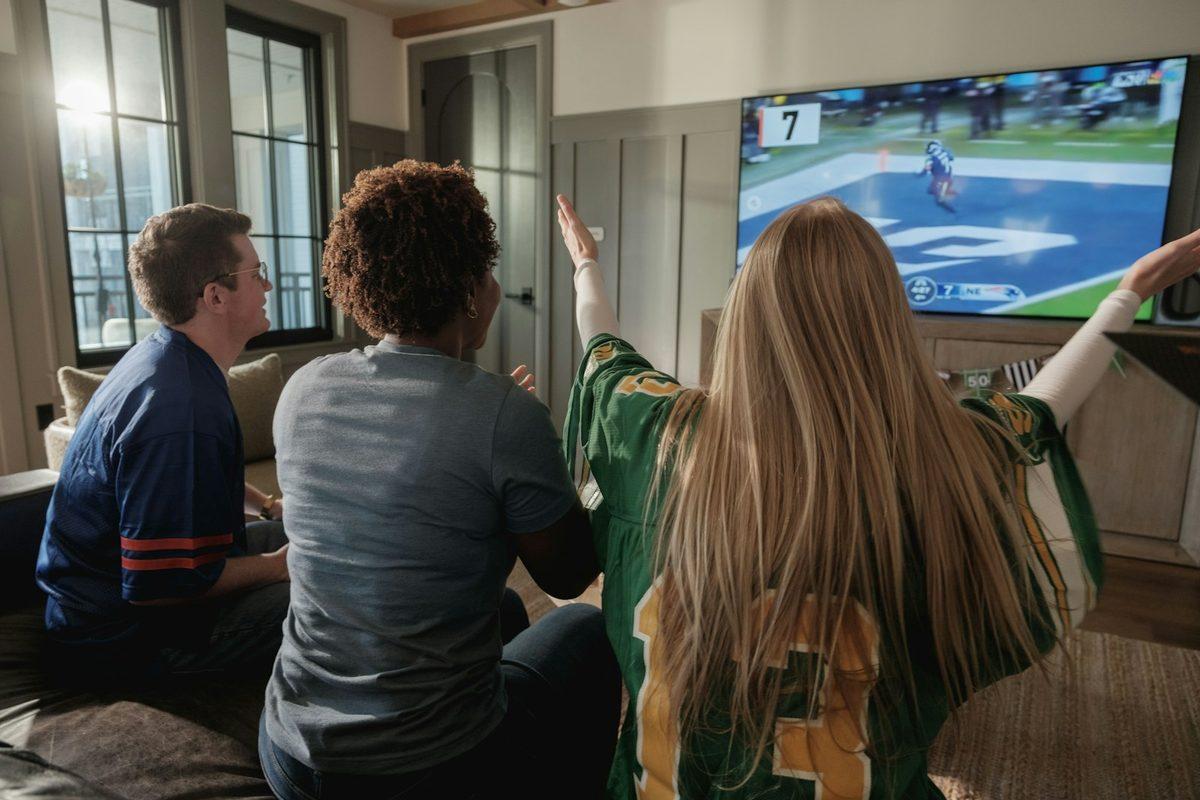
A sponsor's dasher board gets three periods of attention. A concourse banner gets a few seconds on the way to the concession stand. Then the game ends, everyone drives home, and the sponsor's connection with that audience stops at the parking lot.
Connected TV changes that. By linking arena visitation to the households those visitors come from, sponsors and media networks can keep reaching the same audience on the largest screen in the home, days or weeks after the final buzzer. For arena operators, it turns a physical audience into a premium video audience that can be packaged, priced, and measured.
This article explains how IP household targeting works for arena audiences, what it is good for, where its limits are, and how to plan a campaign around it.
What connected TV means for arena marketers
Connected TV (CTV) refers to television content streamed over the internet to a TV screen, whether through a smart TV, a streaming stick, a game console, or a set-top box. Ad-supported streaming services sell video inventory on these screens, and much of it can be bought programmatically, with targeting applied to each impression.
For arena marketers, CTV has three qualities that matter:
- It is a lean-back, full-screen environment. Ads play on the main household screen, usually with sound on, and are typically not skippable.
- It is household-level. A TV is a shared device. Targeting reaches the home, not one person.
- It is addressable. Unlike a traditional broadcast buy, CTV impressions can be directed to specific households based on audience data.
That last point is what makes it possible to say "show this ad to households that sent someone to a hockey game at our arena this season" rather than "show this ad to everyone watching a regional sports channel."
How IP household targeting works
The mechanics are simpler than they sound. Here is the general flow, from arena visit to CTV impression.
Step 1: Observe arena visits
It starts with privacy-compliant, aggregated and anonymized mobile location data. Devices that have opted into location sharing through apps are observed within the geofenced boundary of an arena. Visits are deduplicated so each device counts once per arena per day, and filtered to remove pass-through traffic and outliers such as staff who are on site every day.
This produces a large base to work from. In 2025, Arenalytics analyzed more than 20 million arena visits from over 4.6 million unique devices across 700+ arena locations in Ontario alone, and the same approach can be applied to any arena in Canada.
Step 2: Associate devices with households
Mobile devices that connect to a home network share that network's public IP address. Through privacy-compliant identity partners, an anonymized arena-visiting device can be associated with the household IP where it regularly appears in the evening and overnight. No names, emails, or street addresses are involved. The output is a list of household IP identifiers, not a list of people.
Step 3: Build the audience segment
Those household identifiers become a CTV audience segment, which can be shaped to fit the campaign. Common ways to define it include:
- By venue. Households linked to one arena or a defined group of arenas.
- By recency. Households with an arena visit in the last 30, 60, or 90 days.
- By frequency. Households that visited repeatedly across a season, which usually points to registered players and their families.
- By geography. Households within a sponsor's trade area or a set of postal codes.
- By behaviour. Arena households that were also observed at a sponsor's category, such as quick-service restaurants or home-improvement retail.
Step 4: Activate through a demand-side platform
The segment is delivered to a demand-side platform or a CTV ad platform, where it is matched against available streaming inventory. When a matched household's TV requests an ad, the campaign can bid for it. Frequency caps, dayparting, and creative rotation are managed in the platform like any other video campaign.
Step 5: Measure what happened
Because the audience was built from location data, the same data can be used to measure outcomes. Exposed households can be compared with a matched group of arena households that were not reached, to see whether exposure was associated with more visits to the sponsor's locations. That is the visitation lift approach, and it is covered in detail in our article on measuring sponsorship ROI with visitation lift studies.
Why arena households are a strong CTV audience
Not every audience translates well to television. Arena audiences tend to, for a few practical reasons.
Hockey is a family decision
Community arenas are full of parents driving kids to practices, games, and tournaments. The person in the stands is often not the person on the ice, and the household is the unit that actually makes decisions about groceries, vehicles, equipment, and weekend meals. Household-level targeting fits that reality better than one-to-one mobile targeting.
The audience is repeat and predictable
A minor hockey family can be at the rink several times a week for an entire season. That repeat presence makes the household link more reliable and gives media planners a stable, refreshable segment rather than a one-off event crowd.
Their behaviour is already visible
Arena audiences are commercially active. Their visits to coffee and quick-service, fuel, grocery and retail locations are measurable. Those overlaps are what tell a sponsor whether a CTV segment is worth building.
Use cases for sponsors, operators, and media networks
For sponsors
A sponsor with in-arena presence can use CTV to reinforce the message at home. The board ad introduces the brand; the CTV spot, seen on the family TV a few days later, deepens it. Sponsors without in-venue inventory can also use arena households purely as a media audience, buying the segment because it matches their customer profile.
Timing can be planned around observed behaviour. If a sponsor's customers visit its stores both before and after arena visits, the flight should run on both sides of key events, not only afterwards.
For arena operators
Operators can add a CTV extension to sponsorship packages, turning a fixed-inventory deal into a multi-channel one. A package that includes boards, a concourse screen, and a CTV audience of the venue's own visiting households is harder for a sponsor to replicate elsewhere and easier to defend at renewal.
For media networks
Networks that sell screens across multiple arenas can sell the audience as well as the screens. A network-wide CTV segment lets an advertiser reach every household connected to the network's venues, with in-venue screens and home screens working together. Comparing networked arenas with arenas outside the network shows whether that combined reach changes what visitors do.
Planning a CTV campaign for an arena audience
A few practical decisions shape most campaigns.
Define the audience narrowly enough to mean something. "Everyone who visited any arena" is large but generic. "Households that visited arenas in our trade area at least four times this season" is smaller and far more relevant for a local sponsor.
Match the flight to the season. Hockey season runs from late summer through spring, with tournament weekends and playoffs creating peaks. Summer camps, lacrosse, and community events keep some arenas busy year-round. Align the flight with the periods when the segment is freshest.
Set sensible frequency caps. Household targeting means several people may see the same ad. Caps that work for individual mobile targeting can feel heavy on a shared screen.
Plan the creative for the room. A CTV ad plays in a living room, often with kids watching. Creative that references the rink, the season, or the community tends to connect better than a generic national spot.
Agree on measurement before launch. Decide on the control group, the outcome (store visits, category visits, or repeat visits), and the reporting window up front. This keeps the post-campaign conversation about results rather than definitions.
Limits and honest caveats
CTV household targeting is effective, but it is not magic, and sponsors respond better to partners who explain the limits.
- Match rates are never 100 percent. Not every arena-visiting device can be associated with a household, and not every household has a CTV device on the ad-supported inventory being bought.
- Households are shared. The person who saw the ad may not be the person who attended the game. For most family-oriented categories, that is a strength; for narrowly targeted products, it is a consideration.
- IP addresses change. Household IP associations need regular refreshing, which is one reason recency-based segments perform best.
- Scale varies by venue. A large multi-pad complex will produce a bigger segment than a single-pad rural rink. Grouping venues by region or network solves most scale issues.
Privacy by design
Every step in this process works with privacy-compliant, aggregated and anonymized data. Devices are observed only when they have opted into location sharing. Household associations rely on IP identifiers, not personal information. Segments are delivered for targeting at the audience level, and reporting is aggregated so no individual or household can be singled out. For sponsors and their legal teams, that structure is easier to review and approve than approaches built on customer records or email matching.
The bottom line
The arena is where the audience gathers. The living room is where they spend their evenings. IP household targeting connects the two, giving sponsors a way to keep the conversation going after the game and giving operators and media networks a premium video product built on their own audience.
Want to see how large a CTV audience your arena or network could support? Request a sample insight and we will show you the household reach, visit frequency, and category overlap behind your venue's audience.